
TW-si, VS, Brilliant: What Diamond Abbreviations Mean
“Ring 18 kt white gold, 7 brilliants 0.1 ct, TW-si.” Sounds like a secret code from a spy film, but it's the most precise short description a piece of jewellery can have. These few characters contain the metal, cut, weight, colour and clarity of the diamonds. Once you can read diamond abbreviations, you know within five seconds what you're holding – and why two seemingly identical rings cost different amounts. We decode TW, si, vsi, F, navette and “fancy”, no loupe required.
- TW stands for Top Wesselton, a very fine white diamond colour. It corresponds to grades F and G on the international D-to-Z scale.
- si stands for “small inclusions” or “slightly included”: small inclusions that a trained grader easily sees at tenfold magnification, but which are usually invisible to the naked eye.
- vsi (“very small inclusions”) is one grade purer, vvsi purer still, if internally flawless.
- Brillant doesn't simply mean “diamond” but a diamond in the round brilliant cut. Navette, heart or pear are other shapes.
- ct is the carat, i.e. the weight: 1 ct = 0.2 grams.
What does TW-si mean for a diamond?
Let's take one of our favourites, the Ring 1AL90W in 18 kt white gold, and read it like a gemmologist:
The key word is total weight: here 0.1 ct is shared between a centre stone of 0.06 ct and six small companions. What makes 18 carat gold special and why white gold is rhodium-plated, we explain in Yellow, White or Rose Gold. And why carat measures something completely different for gold than for diamonds, read in our article on the first C, carat.
What colour is a Top Wesselton diamond?
A colourless diamond is rarely truly colourless. Most have a hint of yellow or brown, and the colour scale measures exactly that hint. Internationally, the scale of the Gemological Institute of America (GIA) from D to Z has become the standard: D is completely colourless, Z already distinctly yellowish. In the German-speaking trade the older terms live on alongside it – and that's where “TW” comes from.
| GIA colour | Trade term | German term | Appearance |
|---|---|---|---|
| D | River | hochfeines Weiß + | completely colourless |
| E | River | hochfeines Weiß | colourless |
| F | Top Wesselton (TW) | feines Weiß + | colourless to the naked eye |
| G | Top Wesselton (TW) | feines Weiß | colourless to the naked eye |
| H | Wesselton (W) | Weiß | white, slightly warmer in comparison |
| I–J | Top Crystal | leicht getöntes Weiß | faint hint of colour |
| K–L | Crystal | getöntes Weiß | visibly tinted |
| M and below | Cape and lower | getönt | distinctly yellowish |
Mapping according to common comparison tables. Laboratories and dealers do not always draw the boundaries of the old terms in exactly the same place.
And why does the GIA scale start at D rather than A? Purely pragmatic: before it was introduced, systems with A, AA or even AAA were in circulation. To avoid confusion, A to C were simply left out and the scale started afresh.
River and Wesselton, by the way, are place references. Wesselton is the name of a diamond mine near Kimberley in South Africa whose stones were once the benchmark for fine white. “River” refers to diamonds from river deposits, prized as particularly colourless.
Top Wesselton looks especially crisp in white gold, because the cool metal reflects no tint. In yellow or rose gold, on the other hand, a faint yellow shimmer almost disappears – one reason why goldsmiths sometimes deliberately choose a lower colour grade for warm gold colours.
What do if, vvsi, vsi and si mean?
Almost every natural diamond carries traces of its formation deep in the Earth's mantle: tiny crystals, fine fissures, clouds. These “internal characteristics” are its fingerprint. Clarity describes how easily a trained grader finds them under a loupe with tenfold magnification.
| Abbreviation (DE) | GIA | Meaning | At 10x loupe |
|---|---|---|---|
| fl / lr | FL | flawless | no inclusions, no surface characteristics |
| if | IF | internally flawless | clean inside, only tiny surface characteristics |
| vvsi | VVS1, VVS2 | very very small inclusions | minute inclusions, hard to find even for professionals |
| vsi | VS1, VS2 | very small inclusions | minor inclusions, difficult to somewhat easy to see |
| si | SI1, SI2 | small inclusions | inclusions easy to very easy to see |
| pi / P1–P3 | I1–I3 | piqué (included) | obvious inclusions, partly visible to the naked eye |
Good news for everyone who wears jewellery rather than examining it under a microscope: with small brilliants as set in eternity rings, tennis bracelets or pavé settings, si is usually indistinguishable from vsi to the naked eye. As the weight of a single stone rises, higher clarity grades become more worthwhile. With several stones you sometimes see details such as TW-vsi/si: the stones then lie within that clarity range, as in the 18 kt yellow gold ring with seven brilliants.
 Ring 1AL90W, white gold7 brilliants 0.1 ct · TW-si€1,380
 Ring, yellow gold7 brilliants 0.1 ct · TW-vsi/si€1,380
 Ring Blume 1Y258W4 navettes 0.47 ct · F-si€5,250
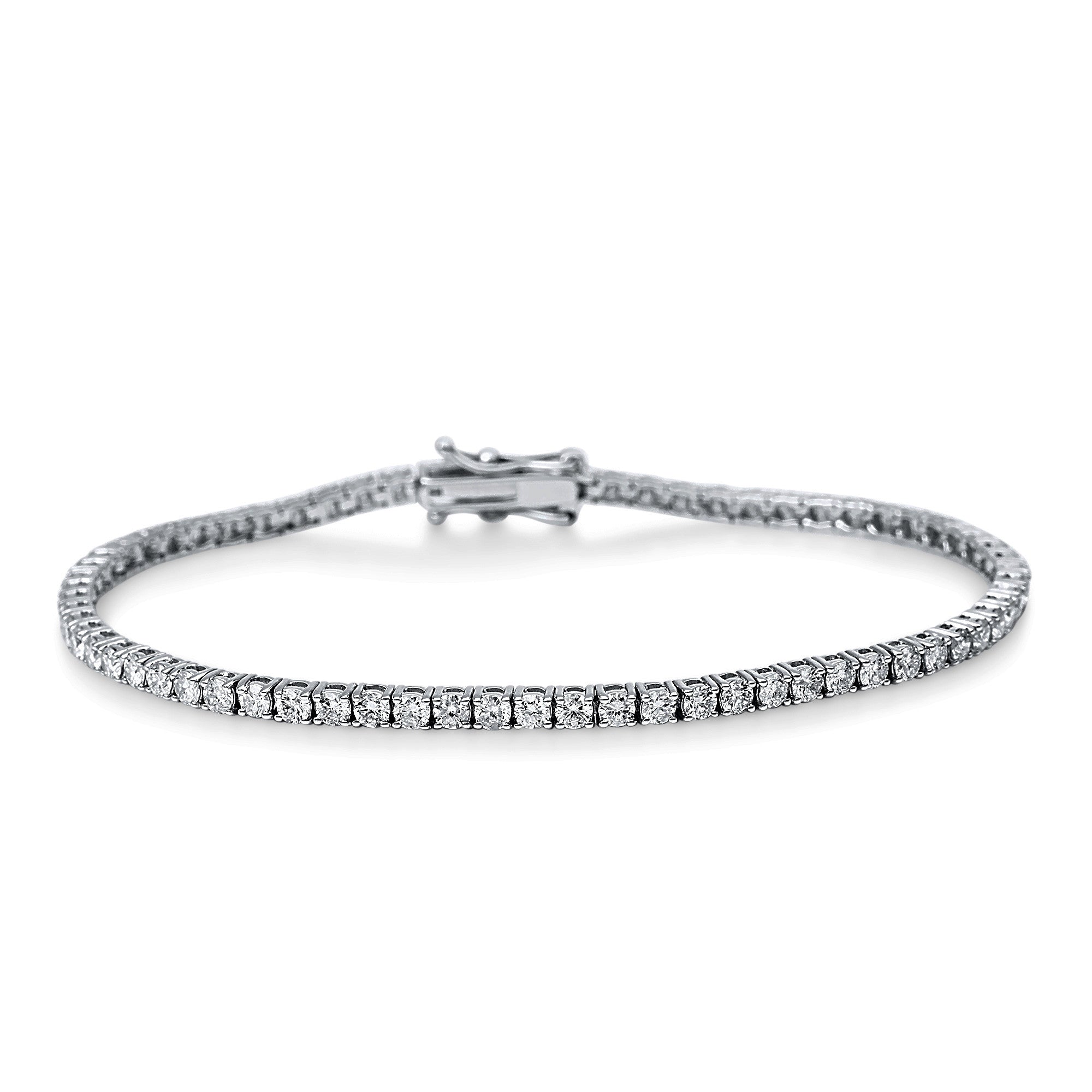
 Tennis braceletbrilliants · TW-sifrom €18,900
Prices according to the 4D OUTFITTERS webshop, as of 20 October 2026. Displayed prices update automatically from the shop.
Is every brilliant a diamond – and every diamond a brilliant?
Every brilliant is a diamond, but not every diamond is a brilliant. In the German-speaking trade only a diamond in the round brilliant cut may be called a “Brillant”. A “cubic zirconia brilliant” is therefore a contradiction in terms. Other cuts have their own names, and you'll find several of them in our product descriptions:
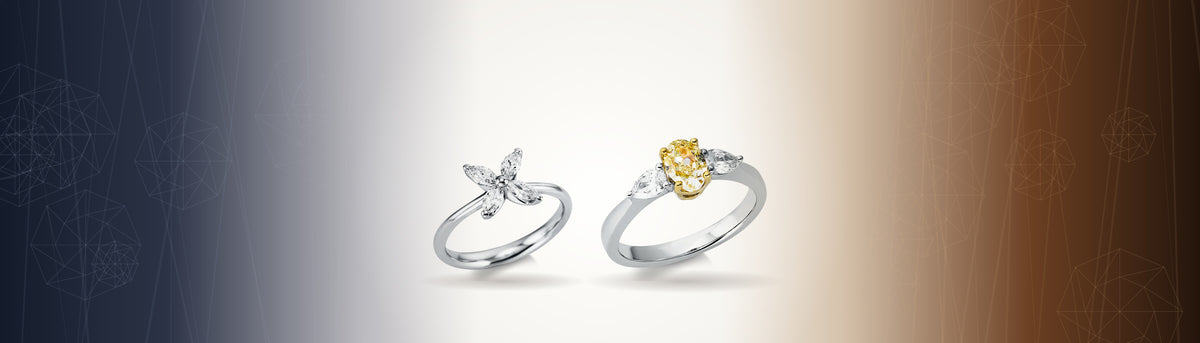
- Navette (internationally marquise): elongated with two points, like a little boat – hence the French name meaning “small shuttle boat”. Four of them form the petals of our flower ring.
- Heart cut and pear cut: romantic shapes that demand particular skill, because any lack of symmetry shows immediately. The Ring 1Y259W combines hearts, navettes and brilliants.
- Oval cut: elegantly elongated, it makes fingers look longer.
The detail F-si on navettes means: colour F, the upper end of Top Wesselton, and clarity si.
What does “fancy” mean for diamonds and sapphires?
The colour scale doesn't stop beyond Z; it changes its logic. Diamonds with more colour than Z are classed as fancy diamonds: intense yellow, pink, blue or green, graded by hue and intensity rather than by letters. One example is the oval yellow fancy diamond in the Ring 1BR09WG, flanked by two pear shapes in TW-si.
With sapphires it's the other way round: the classic sapphire is blue. Sapphires in every other colour, from pink and orange to violet, are known in the trade as fancy sapphires. The Ring 1Z289R in rose gold carries 21 of them. If you prefer semi-precious stones in Fairmined gold, find inspiration in our article Noën Stellini: Which Gemstone Suits You?
Curiosities about diamond abbreviations
Everything that has happened between D and Z
- “Imperfect” became “included”
When GIA introduced its clarity system in 1953, the I in I1 and I2 stood for “imperfect”. In the 1990s it became the friendlier “included”.
- France sticks to tradition
According to GIA, a very slightly included diamond is still called a “VS” in France – “very slightly imperfect”, just thought in French.
- 2,000 years of diamond grading
According to GIA, colour, clarity and weight were already the basis of the first diamond grading system, established in India over 2,000 years ago.
- Blue thanks to boron
Blue diamonds usually owe their colour to tiny amounts of boron in the crystal lattice. The most famous blue diamond is the Hope at 45.52 carats. A perfume is named after it too – more in our portrait Thameen London.
- The expensive blue
The 14.62-carat “Oppenheimer Blue” was auctioned in Geneva in 2016 for 50.6 million US dollars.
- Diamonds from the factory
The first synthetic diamond was produced by engineer Erik Lundblad at ASEA in Sweden as early as 15 February 1953. How lab-grown diamonds differ from natural ones today, read in natural and lab-grown diamonds.
- Carat: 1 ct = 0.2 grams = 100 points. A 0.10 ct stone therefore weighs 0.02 grams.
- 4Cs: carat, colour, clarity and cut. GIA developed the system in the 1950s.
- Clarity grades: the GIA system started in 1953 with nine grades. IF and I3 were only added in the 1970s.
- Piqué: the designation P1 to P3 comes from French and roughly means “dotted”.
- Fancy: fancy diamonds are graded by hue and intensity, not on the D-to-Z scale.
Frequently asked questions about diamond abbreviations
What does TW-si mean for diamonds?
TW stands for Top Wesselton, a fine white colour corresponding to GIA colours F and G. si stands for small inclusions that are easy to see at tenfold magnification but usually not with the naked eye.
Is TW-si a good quality?
Yes. Top Wesselton belongs to the colourless grades, and with small brilliants in jewellery si is usually indistinguishable from higher clarity grades to the naked eye. TW-si therefore offers an excellent balance of beauty and value.
Which is better: vsi or si?
vsi is the purer grade. The inclusions are smaller and harder to find. For larger single stones vsi can be worthwhile; with small pavé brilliants the difference is barely visible.
What is the difference between a brilliant and a diamond?
Diamond is the material, brilliant is the cut. Only a diamond in the round brilliant cut may be called a brilliant. Navette, heart, pear or oval are other cuts of the same material.
What does F-si mean?
F is a colour grade on the GIA scale and belongs to Top Wesselton. si describes the clarity with small inclusions. F-si is therefore a very white colour with good clarity.
What is a fancy sapphire?
That's what the trade calls sapphires in all colours except blue, such as pink, yellow, orange or violet.
See it, don't just read it
Abbreviations are practical, but a diamond only comes alive in the light. Visit our boutique in Bregenz, hold TW-si and TW-vsi side by side, and let us show you how a navette sparkles compared with a brilliant. Every piece from our 4D OUTFITTERS Fine Jewellery comes with a certificate and in our gift box. Would you like to know something in advance, are you looking for a particular stone or need a ring size? Simply send us a message, we'll be happy to advise you.
Browse on: Gold rings · Gold bracelets · Gold earrings. And if you'd like to know what lies behind the “Fairmined” label, read the journey to Noën's Fairmined gold.
Your 4D OUTFITTERS team, Bregenz
Sources: GIA: Diamond Quality Factors · Wikipedia: Diamond color · Wikipedia: Diamond clarity · Wikipedia: Diamant · Renésim: Top Wesselton




Leave a comment
This site is protected by hCaptcha and the hCaptcha Privacy Policy and Terms of Service apply.