
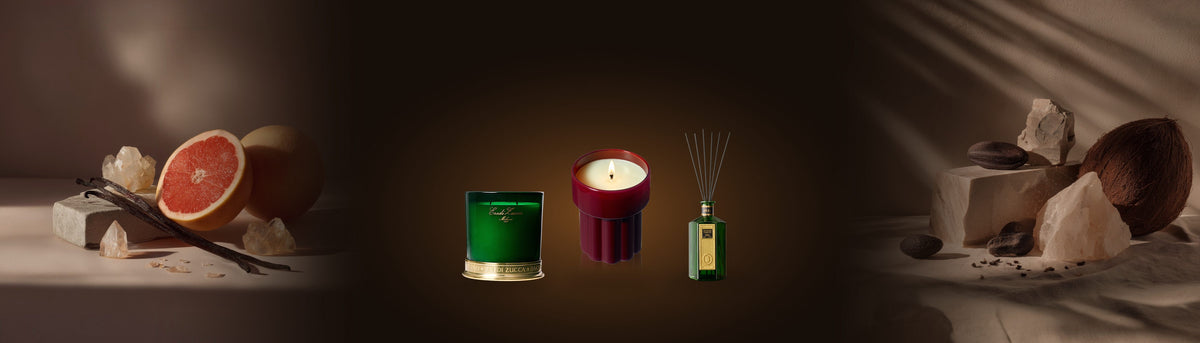
Scented Candles & Home Fragrance: How to Use Them Right
The word perfume comes from smoke, not from skin: its Latin roots, “per” and “fumare”, mean “through smoke”. Long before anyone sprayed scent on a wrist, people let it rise through a room. Today the descendants of those smoke offerings are called scented candles, home fragrance and diffusers. We show you how to burn a scented candle properly, where a diffuser belongs, why you can barely smell your own home fragrance after a few days and how to match your home and your perfume.
- The first burn decides everything: let the candle burn the first time until the wax has melted right to the edge. Rule of thumb: one hour per 2.5 cm of diameter.
- Trim the wick to about 6 mm before every lighting. Burn for no more than 4 hours at a time.
- Diffuser instead of flame: the reeds draw the fragrance oil upwards and it evaporates without heat. Flipping them refreshes the scent.
- Your nose gets used to it: a scent that is always around is perceived more weakly. Your guests still smell it.
- One scent per room usually looks more elegant than three scents shouting over each other.
Scented candle, diffuser or spray: which suits which room?
In short: the candle is for mood, the diffuser for duration, the spray for a quick entrance. A scented candle needs attention, because it only burns while someone is in the room. In return it delivers what no other format can: light, warmth and a scent that builds slowly with the flame. Ideal for the living room and dining area in the evening.
A reed diffuser works around the clock and in complete silence. It suits the entrance, guest bathroom or study, rooms where you don’t want to watch over a flame. A room spray, finally, is the espresso of home fragrance: short, intense, instantly there. Perfect just before the doorbell rings.
A simple rule from our boutique in Bregenz: the smaller the room, the quieter the scent. A guest bathroom cannot handle a candle with 350 grams of wax and powerful oud; a generous living room certainly can.
 TobaTonkaXerjoff · tobacco, tonka, cardamom€ 195
 Bigli CandleEredi Zucca · bergamot, tea rose, maté€ 159
 Last DrinkChambre52 · grapefruit, amber, vanilla€ 95
 Figuier SacréHellenist Paris · fig, incense€ 80
Prices live from our shop, as of 23 Oct 2026. The full selection is in Scented Candles & Home Fragrance.
How do you burn a scented candle properly?
With patience the first time. Wax has a memory. If the candle goes out before the surface has melted to the edge, a so-called memory ring forms. Every time you light it after that, the flame only melts this small circle and the candle digs down like a tunnel. Expensive, fragrant wax is left unused at the rim.
The National Candle Association, the US association of candle makers, therefore recommends one hour per inch of diameter, that is per 2.5 centimetres, for the first burn. A candle 8 centimetres across needs a good three hours the first time. Eredi Zucca and Chambre52 say the same in their care instructions: let it burn until the whole surface is liquid.
After that, three simple rules apply:
- Trim the wick to about 6 mm before every lighting. A long wick soots, flickers and burns the wax too fast. According to the NCA, regular trimming can extend burn time by up to 25 percent.
- No more than 4 hours at a time. Then put it out and let it cool for at least two hours.
- Keep it out of drafts. Open windows, fans and walkways make the flame dance, and a dancing flame soots.
Never leave a candle burning unattended. Keep at least 30 cm from curtains, books and anything flammable, and a good 7.5 cm between two candles. Put out every flame before going to bed or leaving the room.
What do cold throw and hot throw mean?
These two terms from the candle world explain why a candle smells different in the shop than at home. Cold throw is the scent strength of the cold, unlit candle. Hot throw is the scent that fills the room once it burns and the liquid wax releases its fragrance.
A strong cold throw is a luxury some houses build in deliberately. Xerjoff writes that the TobaTonka candle releases its scent even before it is lit. It is hand-poured into a Limoges porcelain vessel and, according to the brand, burns for around 45 hours. The empty vessel then stays on the shelf as an object.
Why can’t I smell my home fragrance after a few days?
Because your nose is an excellent bouncer. Whatever is there all the time eventually doesn’t get in. Experts call this adaptation and habituation: with repeated exposure the response to an odour weakens and perceived intensity drops fairly quickly.
How persistent this effect is was shown by a 1996 study by Pamela Dalton and Charles Wysocki. Participants lived with a particular scent at home for two weeks. Afterwards they smelled exactly that scent more weakly, while their noses stayed normal for other odours. For most of them the effect was still measurable up to two weeks after the exposure ended.
In everyday life this means: don’t add more just because you can no longer smell it yourself. Your guests notice the scent as they come in. It is better to alternate scents, for example a fresh one for the day and a warm one for the evening. You know the same principle from perfume on your own skin, more on that in our 10 tips for applying perfume.
How does a reed diffuser work and where should it go?
Without electricity or flame, with pure physics. The reeds draw the fragrance oil upwards by capillary action, much like a wick or a plant stem. It evaporates from the surface of the reeds and spreads through the room. Rattan is particularly suitable because it is porous and has fine channels running along its length. Synthetic fibre reeds are more uniform but usually wick less.
Three tricks from practice:
- Flip the reeds when the scent fades. The freshly soaked end comes to the top and gives the room a short boost.
- Place it at chest height. Eredi Zucca recommends this for its diffusers, and it makes sense: that is where you breathe.
- Near the door, not in a corner. Gentle air movement spreads the scent; direct sun and radiators make it evaporate faster.
 Bigli Room DiffuserEredi Zucca · 500 ml€ 185
 Porta Orientale Room DiffuserEredi Zucca · lemon, mint, tonka€ 185
 Arabian NightsNaumov · car & room fragrancefrom € 18.90
Prices live from our shop, as of 23 Oct 2026. More from Eredi Zucca in the Eredi Zucca collection.
How much scent can a room take?
Less than you think. A home fragrance should welcome you, not hug you until you run out of air. Our experience for your home:
| Room | Format | Scent direction |
|---|---|---|
| Entrance, hallway | Diffuser | bright and clear, citrus, green notes |
| Living room | Candle in the evening, diffuser by day | warm, woody, tonka, tobacco |
| Dining area | Candle only after the meal | subtle; while eating, every scent competes with the plate |
| Study | Diffuser | fresh, aromatic, mint, herbs |
| Guest bathroom | Small diffuser or spray | clean, light, never heavy |
| Car | Spray, sparingly | light; the interior is tiny |
In the car especially: one spray onto fabric instead of three into the air. Naumov says it makes its car and room fragrances by hand in Germany and describes the car range as “Parfum d'intérieur” with more than 30 percent fragrance oil. That is a concentration to take seriously. You’ll find the scents in the Naumov collection.
Can I match my perfume and my home fragrance?
Yes, and it may be the most elegant trick of all. Some perfume houses offer their scents in both worlds. Chambre52 makes Soleil Tonka as an eau de parfum and as a candle: coconut, vanilla, sea salt and tonka on the skin, a solar accord with tonka and Ambroxan in the room. If you want to know more about Ambroxan, the story of this molecule is in our article Iso E Super, Ambroxan, Hedione.
You don’t have to choose the same brand, though. It is enough if room and skin come from the same scent family. A warm gourmand perfume pairs with a candle of tonka and vanilla, a tobacco scent like Tobacco Memories with Xerjoff’s TobaTonka. Which families exist and how they are built is explained in our fragrance pyramid guide.
 Soleil Tonka PerfumeChambre52 · for the skinfrom € 12
 Soleil Tonka CandleChambre52 · for the room, 200 g€ 95
Prices live from our shop, as of 23 Oct 2026. All of the brand’s scents and candles are in the Chambre52 collection.
Curiosities from the world of home fragrance
From temple walls to spermaceti
- Perfume comes from smoke
The word goes back via French to the Latin “per” (through) and “fumare” (to smoke). In 16th-century English, “perfume” still meant the fumes of a burning substance.
- A recipe on a temple wall
In ancient Egypt people burned kyphi. Recipes for it are inscribed in the temples of Edfu and Philae, and the Greek author Plutarch counted 16 ingredients.
- Candles made of papyrus
The Romans are credited with the wicked candle: rolled papyrus dipped in tallow or beeswax.
- Light from the sperm whale
In the late 18th century, candles made of spermaceti, a wax from the head of the sperm whale, burned so brightly and evenly that they became the first “standard candles” for measuring light.
- A chemist saves the nose
In the 1820s Michel Eugène Chevreul extracted stearic acid. Stearin burned more cleanly than smelly tallow, and from the 1850s paraffin from petroleum followed.
- Two weeks of scent, two weeks of after-effect
If you live with a scent at home for two weeks, you smell it more weakly afterwards, according to a study, often for another two weeks.
- Burn formula: first burn about 1 hour per 2.5 cm of diameter; after that no more than 4 hours, at least 2 hours’ break (National Candle Association).
- Wax blend: according to the maker, Eredi Zucca candles are 70 percent paraffin and 30 percent soy, with a cotton wick and 350 g fill.
- Cold throw vs. hot throw: scent strength of the cold candle versus the scent while burning.
- Capillary action: diffuser reeds carry the oil upwards in fine lengthwise channels; the room air lets it evaporate.
- Study: Dalton & Wysocki, Perception & Psychophysics 58 (1996), pp. 781–792: adaptation to a scent after two weeks of continuous use in one’s own home.
Frequently asked questions about scented candles and home fragrance
How long should you burn a scented candle the first time?
Until the wax has melted to the edge. As a rule of thumb, one hour per 2.5 cm of diameter. Otherwise a ring forms and the candle burns down like a tunnel.
Why does my scented candle soot?
Usually the wick is too long or the candle is in a draft. Trim the wick to about 6 mm before every lighting and put the candle in a calm spot.
How long does a reed diffuser last?
That depends on size, room temperature and air movement. Warmth and sun make the oil evaporate faster. Flip the reeds only now and then and the diffuser lasts longer.
Why can’t I smell my home fragrance any more?
Your nose gets used to scents that are always there. Guests still smell it. Rather alternate between two scents than add more.
Can I use home fragrance in the car?
Yes, sparingly. In a small interior one spray is usually enough. Ideally spray while the car is parked and air it briefly if the scent is too strong.
Does a scented candle go with my perfume?
It looks most beautiful when both come from the same scent family, for example warm and vanilla or fresh and citrus. Chambre52 even makes Soleil Tonka as a perfume and as a candle.
Smell first, then fall in love
A home fragrance is the perfume of your home, so it deserves the same care. If you are looking for your favourite scent for skin and room, start with the perfume. With every perfume we include a 2 ml sample of the same scent; from an order value of € 90, four more 2 ml samples of your choice, while stocks last (wishes in the order comment). From an order value of € 200, standard shipping to Austria and Germany is free.
Candles and diffusers are best smelled in our boutique in Bregenz. There they stand open, cold and sometimes lit, so you can compare cold throw and hot throw yourself. And if you are still looking for a present, our guide Giving perfume as a gift will help.
Your 4D Outfitters team, Bregenz
Sources: National Candle Association: Burning a Candle Correctly · NCA: Fire Safety Tips · NCA: History of Candles · French Color & Fragrance: Scent Throw · Makesy: Diffuser Glossary · Dalton & Wysocki 1996 · Pellegrino et al. 2017 · Etymonline: perfume · Wikipedia: Kyphi · Naumov: About us · Chambre52: Candles





Leave a comment
This site is protected by hCaptcha and the hCaptcha Privacy Policy and Terms of Service apply.