
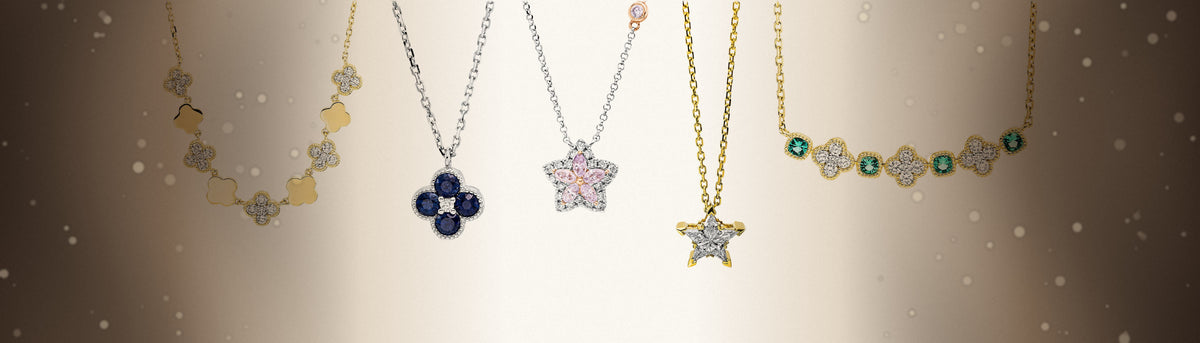
Chain length: which necklace suits you?
Two and a half centimetres decide whether a pendant rests in the little hollow at the base of the neck or on the collarbone, whether it disappears into a neckline or sparkles exactly where it should. The right chain length is the most underrated detail when buying jewellery. We explain which lengths exist, which one suits you and your neckline, what a collier actually is and which type of chain carries a pendant best.
- Common lengths in shops are 40, 42, 45 and 50 cm. Many colliers can be adjusted with an extra ring.
- 40 to 45 cm is the all-rounder: the pendant sits at the base of the neck or just below the collarbone.
- The neckline matters too: a V-neck loves a pendant, a turtleneck a long chain, an off-the-shoulder dress a short one.
- For layering allow about 5 cm between two chains, for example 40, 45 and 50 cm.
- For pendants cable, box and rope chains are particularly sturdy. Snake and Singapore chains prefer light pendants.
Which necklace lengths are there?
Necklaces have names that come mainly from the English-speaking jewellery world. The centimetre values vary by a few centimetres from source to source, but they work well as a guide:
| Name | Length | Where the chain sits |
|---|---|---|
| Collar | up to approx. 35 cm | close and high on the neck |
| Choker | approx. 35 to 40 cm | at the base of the neck |
| Princess | approx. 43 to 48 cm | just below the collarbone |
| Matinee | approx. 50 to 60 cm | above the bust |
| Opera | approx. 60 to 85 cm | below the bust, can also be worn doubled |
| Rope or sautoir | from approx. 80 to 90 cm | long, for knotting or wrapping several times |
In German-speaking shops people usually just talk in centimetres. 45 cm, or 18 inches, is considered the most common length for women's necklaces. Many of our colliers are adjustable: the clover collier 4L436W, for example, can be closed at 40.7, 43.2 or 45.7 cm. These odd numbers are no coincidence; they are exactly 16, 17 and 18 inches, the international standard lengths.
Which chain length suits me?
The table applies to an average neck. In practice three things matter:
- Your neck and build. On a slim neck a 40 cm chain sits lower than on a stronger one. Short chains look harmonious on petite people; longer chains create balance with broader shoulders.
- The pendant. It pulls the chain down into a V. A large pendant with a long bail sits noticeably lower than the chain length suggests.
- The thickness of the chain. A thick chain looks shorter than a fine one of the same length because it needs more circumference.
Our tip: lay a piece of string or a tape measure loosely around your neck and look in the mirror to see where you would like the pendant to be. The length you read off is your length.
Which chain suits which neckline?
Short or clearly below
A short chain that stays above the neckline, or a long one that hangs clearly below it. Just not exactly on the edge of the neckline.
A pendant as an extension
A pendant or a Y-necklace repeats the line of the V and has a lengthening effect. Round, close-fitting colliers work less well.
Long and striking
Matinee or opera length over the jumper, ideally with a bold pendant or thicker links.
Open: fine, buttoned: bold
With an open collar, a fine chain with a small pendant directly on the skin. If the shirt is buttoned up, the chain may lie over it and be longer.
Short shows the décolleté
Choker or short princess length, so that neck and shoulders are shown off.
A piece that stays put
A collier with a fixed centre piece always sits right and does not slip, not even on the dance floor.
What is the difference between a chain and a collier?
The word collier comes from French and, like the English collar, goes back to the Latin collum, the neck. In German, Collier stands for a valuable necklace, often with gemstones or pearls. In the jewellery trade it usually means a chain with a fixed centre piece or pendant.
For our colliers this is stated in the description: "pendant fixed" means the piece sits firmly in its place in the middle. "Pendant not fixed" means it glides along the chain and finds the lowest point by itself.
Which types of chain are there?
The links decide how a chain falls, how it shines and how much it can carry. The most important types at a glance:
| Chain type | What it looks like | For pendants |
|---|---|---|
| Cable chain (Anker) | round or oval links hooked into each other like a ship's chain | very good, the classic |
| Curb chain (Panzer) | flat links lying close together, comfortable to wear | good, robust |
| Box chain (Venezianer) | small cube-shaped links | very good, also for heavier pendants |
| Rope chain (Kordel) | looks like several twisted cords | good, very shiny |
| Figaro chain | three short round links, then one long oval one | good, also for charms |
| Snake chain | smooth and flexible, almost like a ribbon | only simple pendants, kinks easily |
| Singapore chain | like a twisted curb chain, sparkles in motion | only light pendants |
| King chain (Königskette) | four links set at an angle per unit, looks square and solid | usually worn without a pendant |
Our cross colliers, for example, hang on a fine cable chain. It is discreet, easy to repair and carries the pendant reliably. A word of caution on terms: the German "Ankerkette" is what English speakers call a cable chain. The English "anchor chain" is a different chain with a bar across each link.
Which clasp is better?
The two most common clasps on fine chains:
- Spring ring: small, round and delicate, typical of fine colliers. It takes a little dexterity.
- Lobster clasp: slightly larger, with a lever and spring, particularly secure and easier to use. The better choice for heavier pieces.
Chains with an extra ring are practical. On our collier DD4N69292W there is such an intermediate ring at 42 cm, while the full length is 45 cm. That way you can wear the same collier shorter with a crew-neck jumper and longer with a V-neck dress.
Colliers in different lengths in our shop
Above, the short and medium lengths up to about 44 cm; below, the adjustable ones, the 45 cm classics and one long collier:
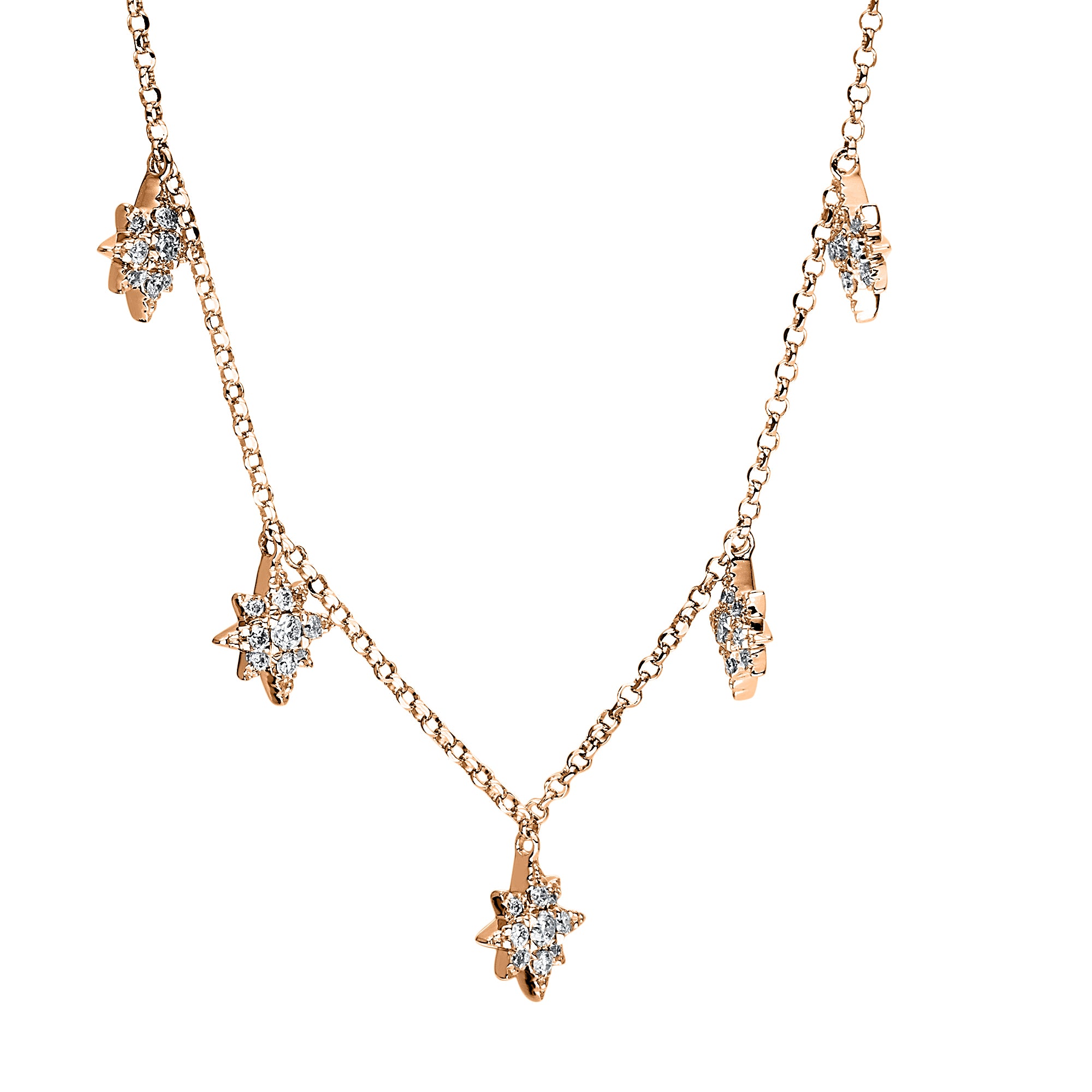
 Collier Stars 4F550R40.6 cm · rose gold, 0.30 ct€2,520
 Cross Collier 3C729G40 or 42 cm · cable chain€3,160
 Star Collier DD4M69824W42 cm · white gold, 0.25 ct€2,920
 Collier 4K939G40.5 to 44.5 cm · yellow gold€4,420
 Clover Collier 4L436W40.7 / 43.2 / 45.7 cm · sapphires€1,990
 Collier DD4N69292W42 or 45 cm · white gold, 0.51 ct€2,990
 Collier 4H535G45 cm · yellow gold, 0.41 ct€2,800
 Collier Zarge Twist 4J497G65 cm · yellow gold, 1.41 ct€7,100
Prices live from our shop, as of 25 Oct 2026. You will find all pieces under Gold Necklaces and the whole line under 4D OUTFITTERS Fine Jewellery.
All colliers shown here are made of 18 carat gold, i.e. 750 gold. What the number in the clasp means is explained in Gold Hallmarks: What 750 & Co. Really Mean, and the difference between the gold colours in Yellow, White or Rose Gold: What Is in 18 Karat?. Abbreviations like TW-si for the diamonds are decoded in TW-si, VS, Brilliant: What Diamond Abbreviations Mean.
How do I combine several chains?
Layering, wearing several chains at once, looks best when each chain has its own place. The usual rule of thumb: about 5 cm apart, for example 40, 45 and 50 cm. That way the chains tangle less and every pendant stays visible. Feel free to combine a fine chain with a pendant, a plain chain without one and a longer one with texture. Whether you stick to one gold colour or mix them on purpose is a matter of taste.
How do I care for my necklace?
- Untangling knots: open the clasp, remove the pendant, lay the chain flat and gently tease the knot apart with two needles. A drop of baby or olive oil helps; wash it with mild soap afterwards. If the knot holds, better bring it to us.
- Storing it properly: keep chains hanging, or each in its own small compartment or pouch. For travelling, fine chains can be threaded through a drinking straw with the clasp closed.
- Taking it off: before swimming, in the hot tub, for sport and for sleeping. Chlorine can discolour gold, and creams and lotions settle between the links.
Suitable jewellery boxes and care products can be found under Jewellery Care & Storage. How delicate the stones on your chain are is shown in our article Gemstone hardness: which stone can handle everyday life?.
Curiosities about the necklace
From shell beads to a queen
-
Jewellery for 142,000 years
In Bizmoune Cave in Morocco, archaeologists found 33 perforated snail shells at least 142,000 years old. They are considered the oldest known jewellery beads in the world.
-
The Affair of the Diamond Necklace
A necklace with 647 diamonds totalling around 2,800 carats shook the French court in 1785. A swindler had ordered it in Marie Antoinette's name. The queen was innocent, but her reputation was ruined all the same.
-
A choker as a trendsetter
Around 1900, wide, close-fitting neckbands became fashionable, supposedly because Queen Alexandra of England used one to hide a small scar.
-
Five kilometres of gold
According to Guinness, the world's longest handmade gold chain is 5 kilometres long and weighs over 240 kilos. Around 100 goldsmiths in Dubai needed 45 days to make it in 2015.
-
Odd centimetres, round inches
40.7, 43.2 and 45.7 cm look random but are exactly 16, 17 and 18 inches. That is why they appear on so many labels.
- Conversion: 1 inch = 2.54 cm; 16" = 40.6 cm, 18" = 45.7 cm, 20" = 50.8 cm, 24" = 61 cm.
- Most common women's length: 45 cm or 18 inches.
- Layering distance: about 5 cm or 2 inches per chain.
- Princess according to GIA: 17 to 18 inches, i.e. around 43 to 46 cm.
- Choker according to GIA: 14 to 16 inches, i.e. around 35.5 to 40.5 cm.
Frequently asked questions about chain length
Which chain length is usual for women?
42 and 45 cm are very common, with 45 cm considered the most common length. At 45 cm a pendant usually sits just below the collarbone.
How do I measure my chain length?
Lay a tape measure or a piece of string loosely around your neck, the way the chain should fall, and read off the length. For an existing chain, measure it open from end to end, clasp included.
Which length for a pendant?
For most pendants 42 to 45 cm is ideal. With high necklines or turtlenecks the chain may also be 50 to 60 cm long.
What is a collier?
A valuable necklace, in the trade usually with a fixed centre piece or pendant. The word comes from the Latin collum, the neck.
Which chain is the strongest?
For pendants, cable, box, rope and curb chains are considered particularly robust. Snake and Singapore chains are more delicate and kink more easily.
Can a chain be shortened or lengthened?
Yes, in most cases. A goldsmith can shorten a chain or add an extension with an extra ring. Just ask us.
You will find the right length in the mirror
The quickest way to find your length is to try on two or three colliers one after the other. Come to our boutique in Bregenz for this, ideally wearing the top the chain is meant to go with. We will measure, hold the mirror and show you how the same collier changes with an adjustable ring. Or write to us, we are happy to advise you personally.
Your 4D Outfitters team, Bregenz
Sources: GIA: Pearl Buying Guide · Blue Nile: Necklace Length Chart · Wikipedia: Halskette · Baur Magazin: chain types · Jewelers Mutual: Necklines · Jewelers Mutual: Clasps · Jewelers Mutual: Untangle · Brilliant Earth: Types of Chains · Etymonline: collar · Wikipedia: Collier · Sehasseh et al., Science Advances 2021 · World History Encyclopedia: Diamond Necklace Affair · Wikipedia: Choker · Guinness World Records · Jewelers Mutual: Safety Tips





Leave a comment
This site is protected by hCaptcha and the hCaptcha Privacy Policy and Terms of Service apply.