
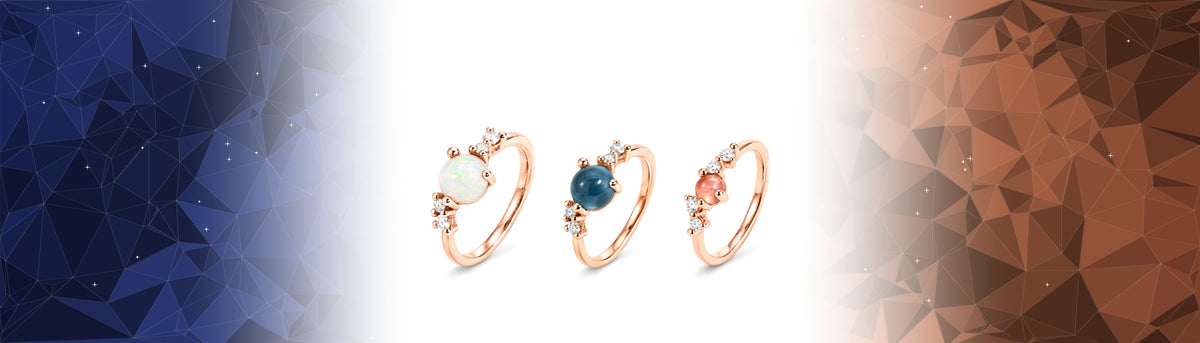
Gemstone hardness: which stone can handle everyday life?
The dust on your windowsill is harder than most of your jewellery. It contains tiny grains of quartz, and quartz has a hardness of 7 on the Mohs scale. Every gemstone that is softer slowly loses its shine over the years. How hard a gemstone really is, why a diamond can still break and which stone suits which kind of everyday life: we explain it here, with examples from our boutique.
- The Mohs scale runs from 1 (talc) to 10 (diamond). It only tells you which mineral scratches which, not how much harder a stone is.
- From hardness 7 everyday dust can hardly harm a stone. Below that, the surface becomes duller over time.
- Hardness is not toughness: a diamond scratches everything but can split along its cleavage planes if it takes a hard knock.
- Robust for every day: diamond, sapphire and ruby. With a little care: emerald, topaz, tourmaline and quartz. For special moments: opal and moonstone.
- Storage: keep every piece separately, because hard stones scratch softer ones and the gold too.
What does the Mohs scale measure?
It measures scratch hardness, in other words: who scratches whom? The mineralogist Friedrich Mohs published the scale in 1822. He chose ten minerals as references, from soft talc to diamond. Each scratches the one before it and is scratched by the next. That is all there is to it, and that is exactly what makes the scale so practical: with a fingernail, a coin and a piece of glass you can roughly classify a stone.
| Mohs | Reference mineral | Absolute hardness (sclerometer) | For comparison |
|---|---|---|---|
| 1 | Talc | 1 | |
| 2 | Gypsum | 2 | fingernail about 2 to 2.5, pure gold 2.5 |
| 3 | Calcite | 14 | copper coin about 3 |
| 4 | Fluorite | 21 | |
| 5 | Apatite | 48 | |
| 6 | Orthoclase (feldspar) | 72 | window glass about 5.5, steel file about 6.5 |
| 7 | Quartz | 100 | household dust and sand |
| 8 | Topaz | 200 | |
| 9 | Corundum (sapphire, ruby) | 400 | |
| 10 | Diamond | 1,500 |
How much harder is a diamond than a sapphire?
About four times as hard, even though there is only one step between them on the Mohs scale. The steps are simply not the same size. Measured with a sclerometer, corundum reaches about 400 and diamond about 1,500. The jump from 9 to 10 is therefore almost three times as large as the whole way from 1 to 9. A diamond does not play in a higher class but in a league of its own.
The everyday consequence: only a diamond scratches a diamond. And a diamond scratches everything else, including the sapphire next to it in the jewellery box and the gold of its own setting.
Why do some gemstones become dull over time?
Because dust grinds. Fine grains of quartz, with a hardness of 7, float in the air and in every household. A study of house dust from six Canadian cities found quartz to be the most common mineral in all samples, probably carried in with street sand. If you wear a stone below hardness 7, you are polishing it every day with fine sandpaper without noticing. Over months and years, edges and surfaces lose their shine.
Gemstones from hardness 7 upwards resist this dust. For rings you wear every day, 7 is therefore a good rule of thumb.
Is a diamond unbreakable?
No. Its name comes from the Greek adamas, “the invincible”, but that only applies to scratching. Diamond has four directions in which it cleaves perfectly. Diamond cutters have used this for centuries, splitting rough stones with a targeted blow. An unlucky knock against a stone edge can do the same to a finished diamond.
Gemmologists therefore distinguish three properties that together make up durability:
Resistance to scratches
Measured on the Mohs scale. Diamond 10, sapphire 9, topaz 8.
Resistance to breaking
How well a stone withstands knocks without chipping. Sapphire and ruby are rated excellent here, topaz and opal as sensitive.
Resistance to the environment
How a stone reacts to light, heat, chemicals and dry air. This is where opal shows its diva side.
Which gemstone can handle everyday life?
The short answer: diamond, sapphire and ruby can cope with almost anything. After that it depends on the piece. A ring takes far more knocks than an earring or a pendant.
The indestructibles: diamond, sapphire, ruby
Sapphire and ruby are the same mineral, corundum, just in different colours. The name comes from the Tamil kurundam. Corundum has no cleavage and is considered particularly tough; with hardness 9 it is the hardest gemstone used in jewellery after diamond. Ideal for tennis bracelets that slide across table tops on the wrist every day.
 Ring 1AP18WBrilliants · Mohs 10€2,120
 Tennis Armkette Fancy SaphireSapphires · Mohs 9from €5,860
 Flex Tennis Armband 5D151RRubies · Mohs 9€8,490
 Flex Tennis Armband 5D325GEmeralds · Mohs 7.5–8€12,980
Live prices from our shop, as of 24 Oct 2026. More in our collection 4D Outfitters Fine Jewellery and among our gold bracelets.
Strong, but with character: emerald and topaz
At 7.5 to 8, emerald is hard enough, but almost every emerald has fine inclusions. According to the GIA, an estimated 90 percent or more of all emeralds are treated with oil or resin to fill these fine fissures. So: no ultrasonic bath, no steam, no heat.
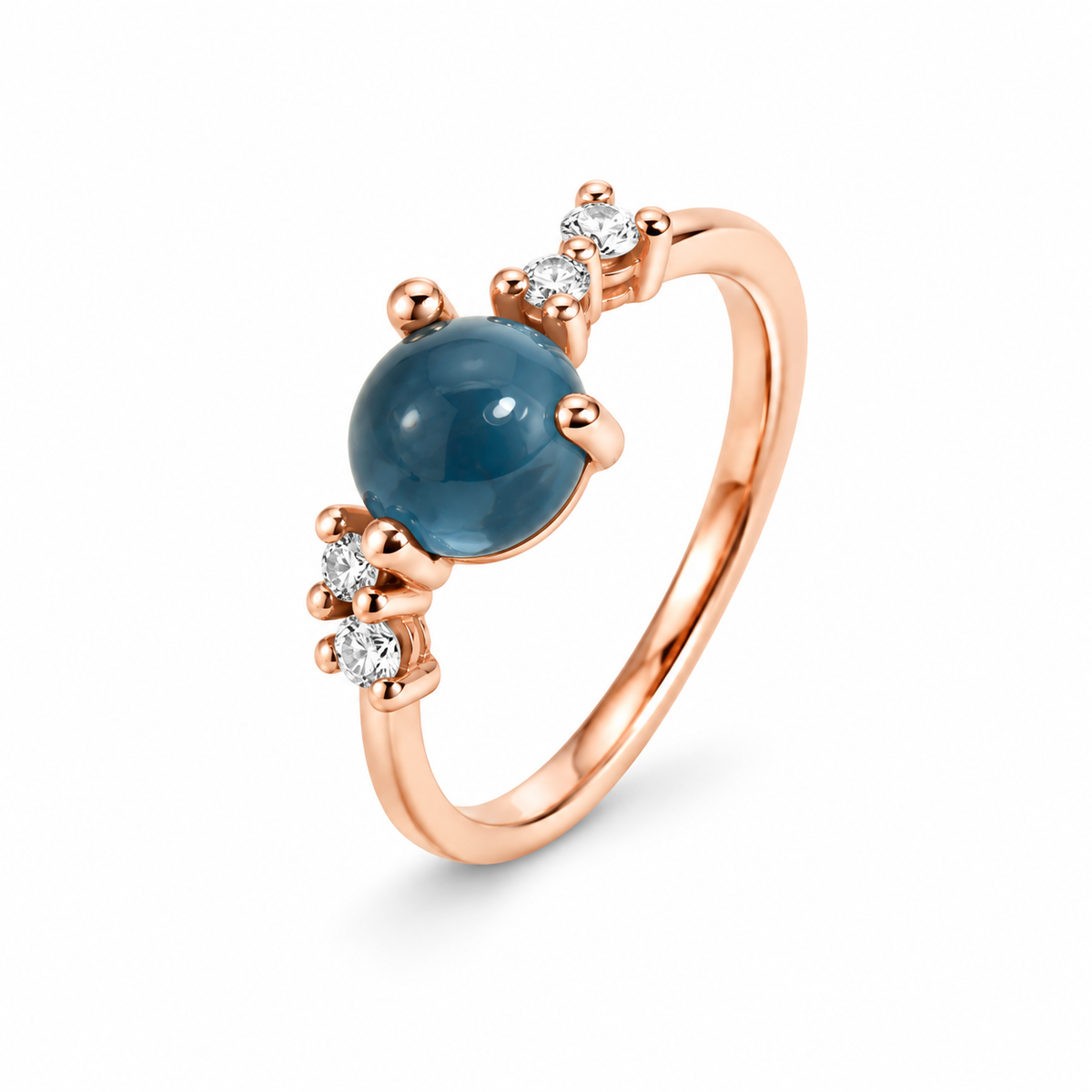
Topaz has a hardness of 8 but a perfect cleavage across its length. A hard knock can split it. Good cutters therefore orient the stone so that the cleavage plane does not run parallel to the top. By the way: intensely blue topazes such as London Blue or Swiss Blue are extremely rare in nature. In the trade they are almost always created from colourless topaz by irradiation and heating, which is common practice in the industry and permanent.
The colourful ones: tourmaline and the quartzes
Tourmaline reaches 7 to 7.5 and is easy to wear every day. Amethyst, citrine, rose quartz, smoky quartz and rutilated quartz are all quartzes with a hardness of 7, exactly on a par with dust. They hardly scratch but deserve their own place in the jewellery box. Amethyst and citrine can fade in strong light over a long time; most citrines on the market, incidentally, are heated amethysts. Lovely examples are the Ring Stellini II with amethyst and the Ring Stellini II with rose quartz by Noën.
The sensitive ones: moonstone and opal
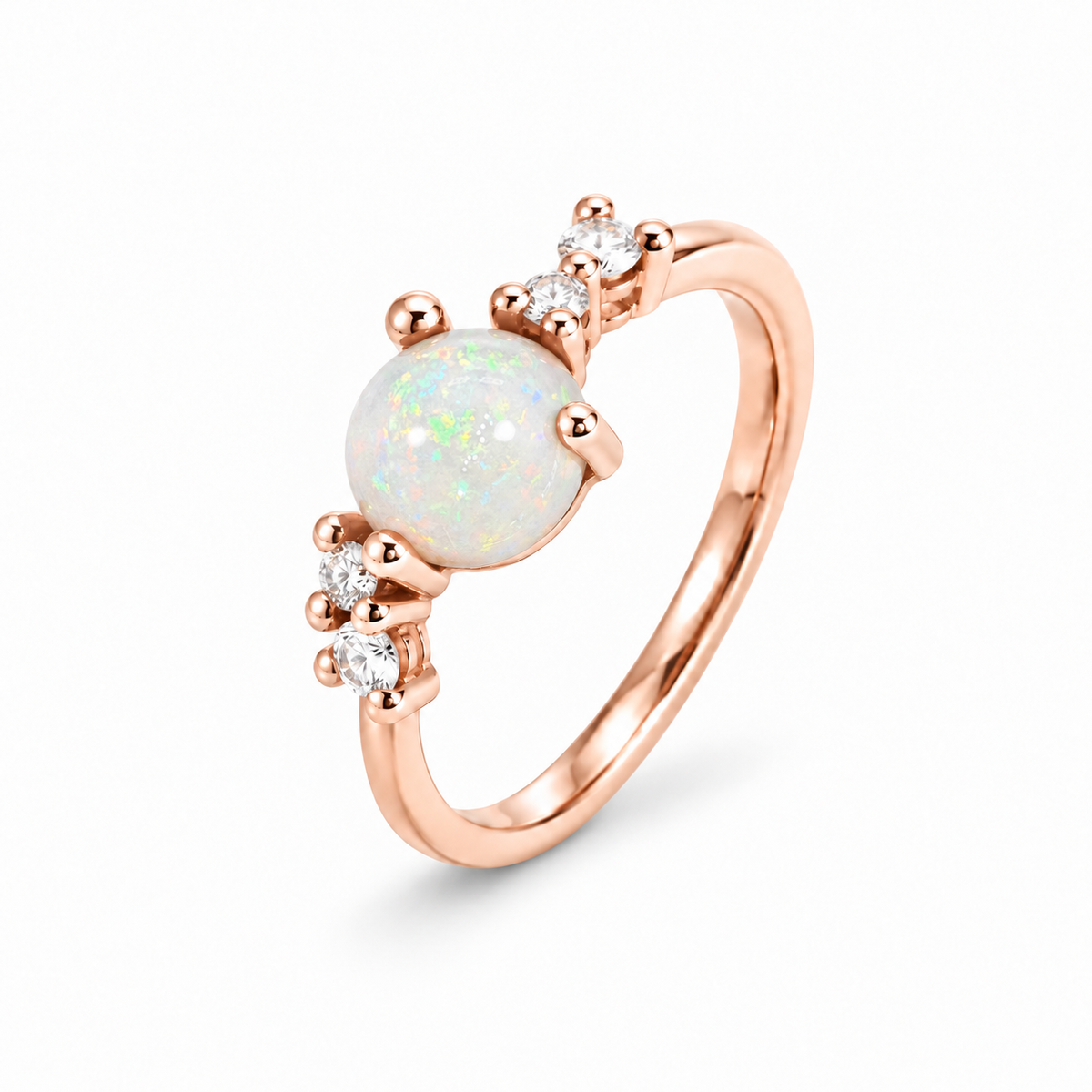
Moonstone is a feldspar of 6 to 6.5 with two cleavage directions. The GIA therefore recommends it for pendants and earrings rather than for rings that have to take a lot. At 5.5 to 6.5, opal is the softest stone in this group and contains water, usually 6 to 10 percent of its weight. Great heat, dry heating air or harsh light can cause fine cracks. That sounds dramatic, but it simply means: opal rings are evening rings, not gardening rings.
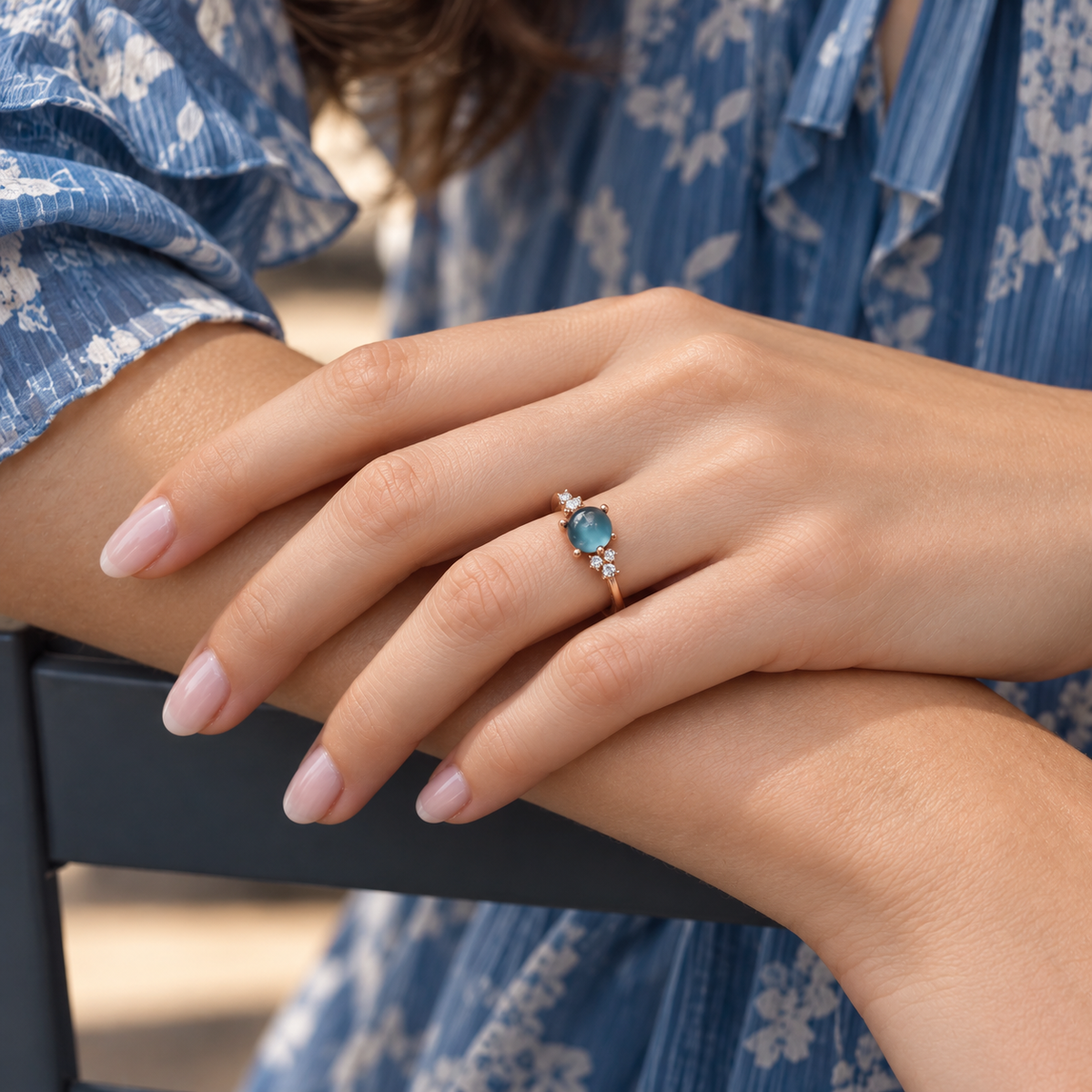
 Ring Stellini IILondon Blue topaz · Mohs 8€2,460
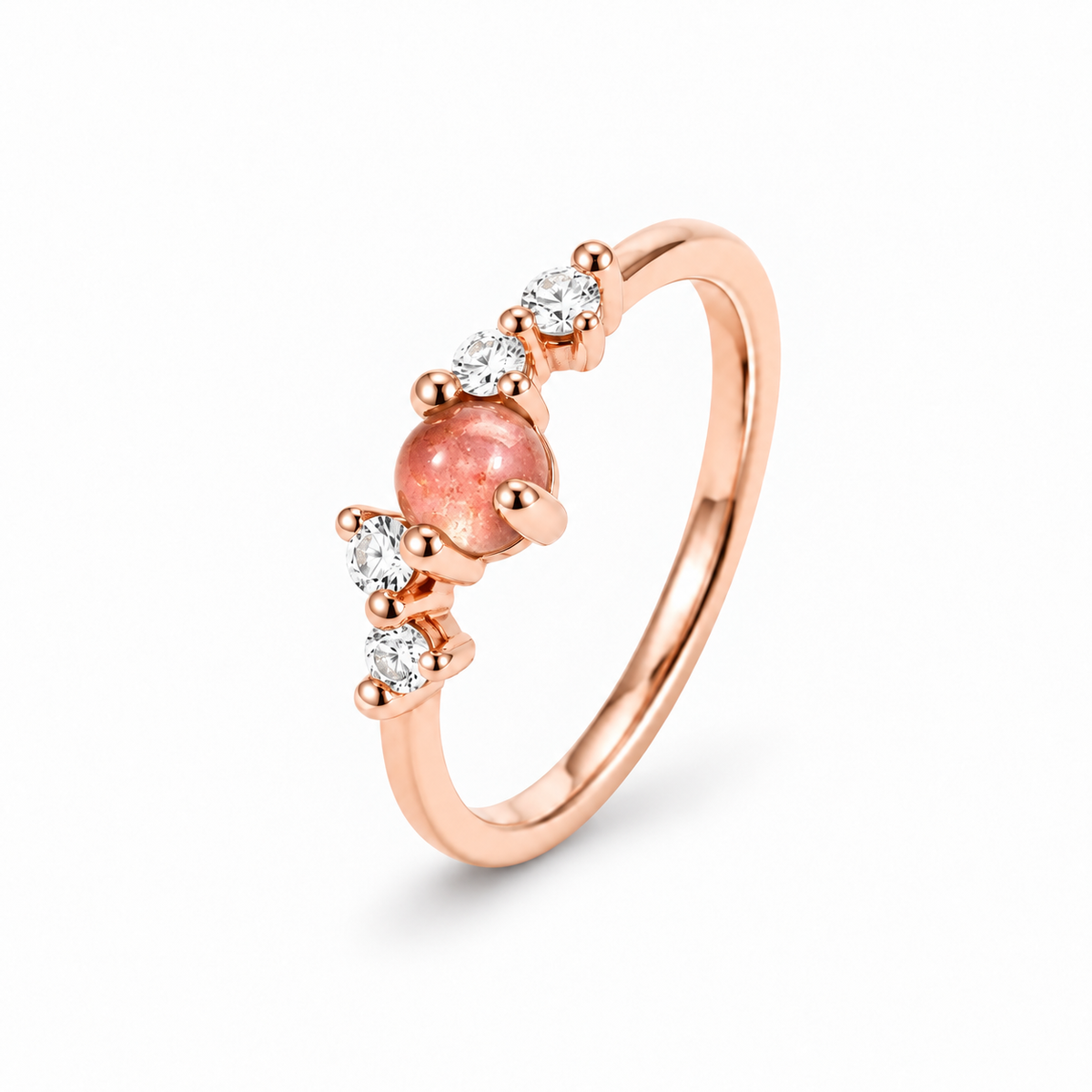
 Ring Stellini IPink tourmaline · Mohs 7–7.5€2,340
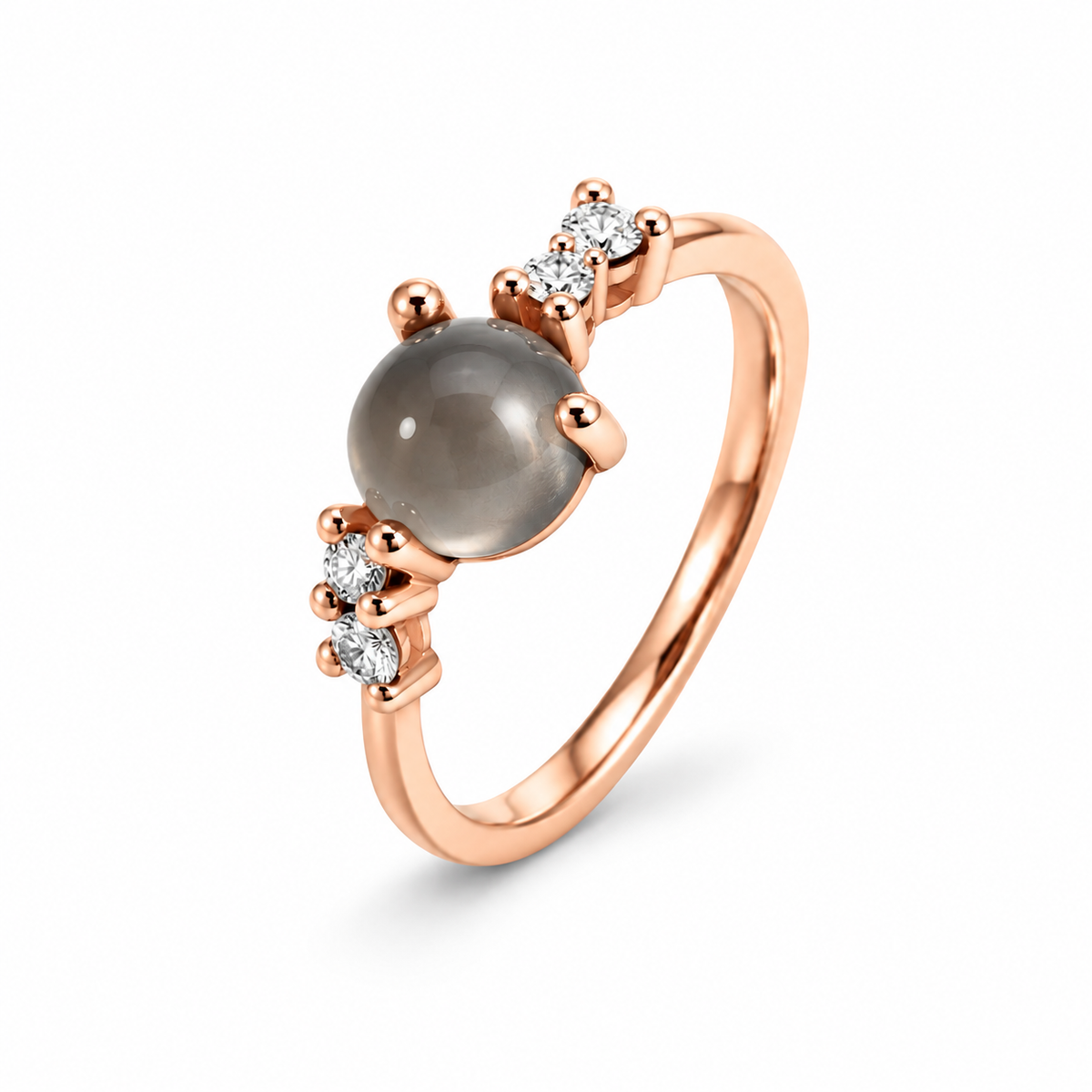
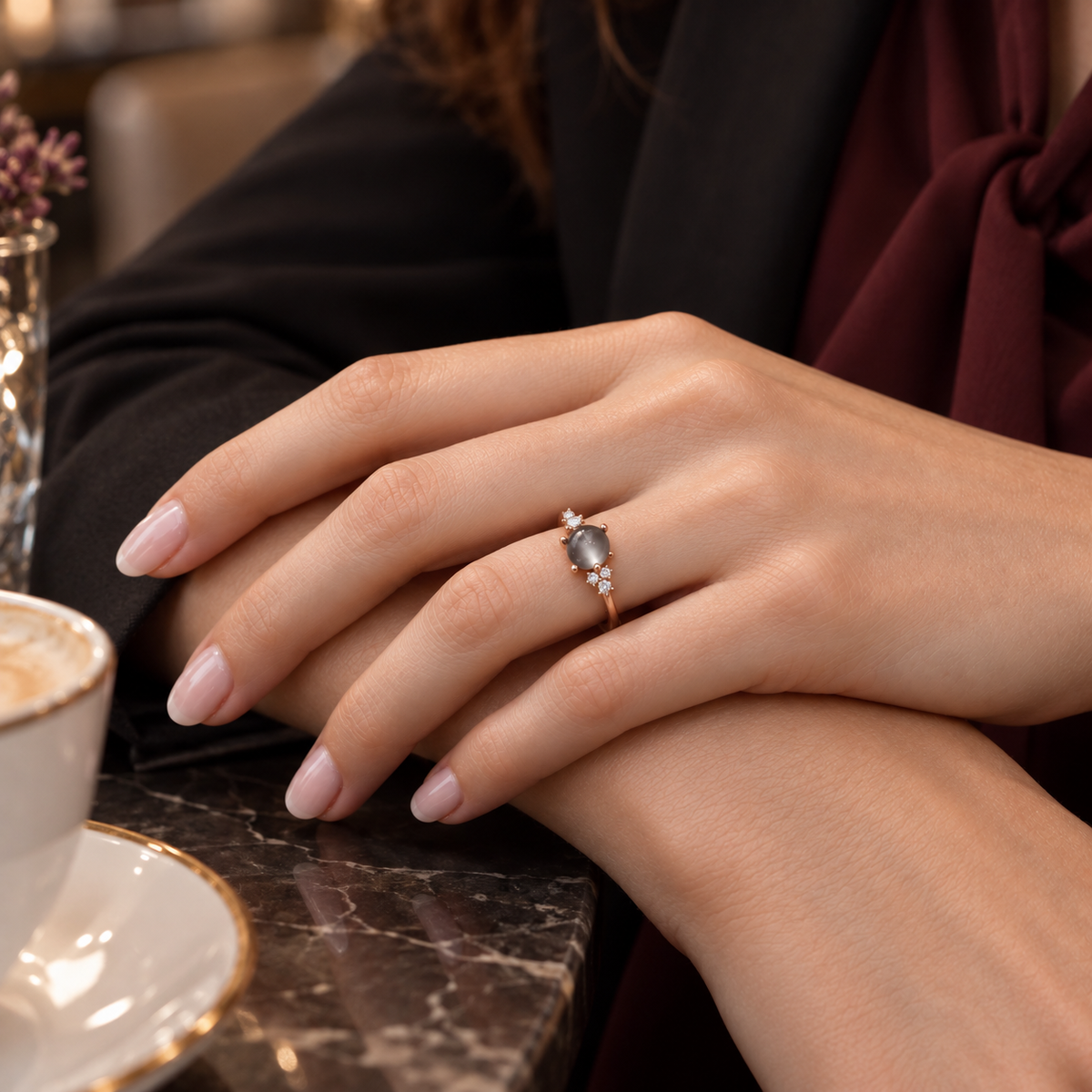
 Ring Stellini IIGrey moonstone · Mohs 6–6.5€2,460
 Ring Stellini IIOpal · Mohs 5.5–6.5€2,460
Live prices from our shop, as of 24 Oct 2026. You will find all pieces by Noën in the Noën Jewellery collection. Which Stellini stone suits you is revealed in our article Noën Stellini: which gemstone suits you?
How hard is gold?
Much softer than any gemstone. Pure gold has a Mohs hardness of 2.5, barely more than a fingernail. Alloyed 18 carat gold is considerably firmer, but still far from quartz. That is why a gold ring shows fine signs of wear after a few years while the stone in it shines as on the first day. A goldsmith polishes this away in a few minutes. White gold is usually rhodium-plated; this layer wears off and can be renewed. What lies behind the gold colours and the fineness is explained in Yellow, white or rose gold.
How do you care for and store gemstone jewellery?
Three simple habits keep your pieces beautiful for decades:
Each piece on its own
In its own compartment or pouch. A diamond ring in the same drawer as an opal pendant makes for a bad flatshare.
Before sport, gardening and cleaning
Knocks, soil and cleaning agents are the worst enemies. Chlorine in the pool and chlorine cleaners can attack gold alloys.
Lukewarm, mild, soft
Warm water, a drop of mild soap, a soft brush. Ultrasound and steam only at the jeweller’s, and never for opal, emerald, topaz and moonstone.
A tip from our boutique: have the rings you wear every day checked once a year. A prong that has opened slightly is hard to see with the naked eye but obvious under a loupe. How our tennis bracelets are set is explained in our tennis bracelet guide.
Curiosities about hardness
Of ash pullers, the invincible and fingernails
-
The invincible that can be split
“Diamond” comes from adamas, invincible. Yet for centuries it has been split with a targeted blow.
-
The gap at the top
Between corundum (9) and diamond (10) lies a bigger jump in hardness than between talc (1) and corundum (9).
-
A stone that attracts ash
Tourmaline becomes electrically charged when heated and then attracts hot ash. According to tradition, Dutch traders called it “aschentrekker”.
-
Sapphire and ruby are twins
Both are corundum. Red is called ruby, all other colours are called sapphire.
-
Gold almost loses to a fingernail
Pure gold has 2.5 on the Mohs scale. A fingernail is about 2 to 2.5.
-
Opal has a drink
Opal contains water, usually 6 to 10 percent of its weight, sometimes up to 21 percent.
- Mohs scale: published in 1822 by Friedrich Mohs, a ranking, not a linear scale.
- Absolute hardness: quartz 100, topaz 200, corundum 400, diamond 1,500 (sclerometer).
- Diamond cleavage: perfect in four directions, parallel to the octahedral faces.
- Emerald: according to the GIA, over 90 percent are treated with oil or resin.
- Blue topaz: in the trade almost always irradiated and heated; the starting material is colourless topaz.
Frequently asked questions about gemstone hardness
Which gemstone is the hardest?
Diamond, with a Mohs hardness of 10. It is followed by sapphire and ruby at 9, both made of the mineral corundum.
Can a diamond break?
Yes. It is extremely scratch-resistant but can chip or split along its cleavage planes if it takes a hard knock.
Which gemstone is best for a ring worn every day?
Ideally stones of hardness 7 or more with good toughness: diamond, sapphire, ruby, plus tourmaline and quartzes such as amethyst. Opal and moonstone are better kept for special occasions.
Is topaz a hard gemstone?
Yes, with a hardness of 8 it is very scratch-resistant. Because of its cleavage, however, it is sensitive to knocks.
Can I clean gemstone jewellery in an ultrasonic bath?
Better not at home. Ultrasound can loosen stones and damage treated or sensitive stones such as emerald, opal, topaz and moonstone. Warm water with mild soap is almost always the safe choice.
Why is my opal turning cloudy or cracked?
Usually because of heat, very dry air or strong light. Opal contains water and reacts to these conditions. Do not keep it on the radiator or in bright sunlight.
Hardness you can touch
You don’t just see the difference between a sapphire and an opal, you feel it when you hold both in your hand. Visit our boutique in Bregenz: we will place the stones side by side and show you under the loupe what matters. Or send us a message if you have a question about a particular piece.
Your 4D Outfitters team, Bregenz
Sources: Wikipedia: Mohs scale · GIA: Mohs Scale · GIA: Gem Durability · CUNY Queensborough: Hardness · University of Ottawa: mineralogy of house dust · GIA: Diamond Care · GIA: Emerald Care · GIA: Topaz Care · GIA: Topaz Quality · GIA: Moonstone Care · GIA: Opal Care · GIA: Citrine · GIA: Caring for Jewelry · Wikipedia: Opal · Wikipedia: Tourmaline



Leave a comment
This site is protected by hCaptcha and the hCaptcha Privacy Policy and Terms of Service apply.