
Parfums de Marly: A Château, Two Horses and a King
A château that has not existed for more than 200 years, two marble horses that now stand in the Louvre, and a Parisian in love with the 18th century. From these ingredients Julien Sprecher created Parfums de Marly, one of the most successful niche perfume houses in the world. Who is behind Parfums de Marly, why are the men's fragrances named after famous racehorses, and which scent is the best place to start?
- Who: Parfums de Marly was founded in Paris in 2009 by Julien Sprecher, who still leads the creative side today.
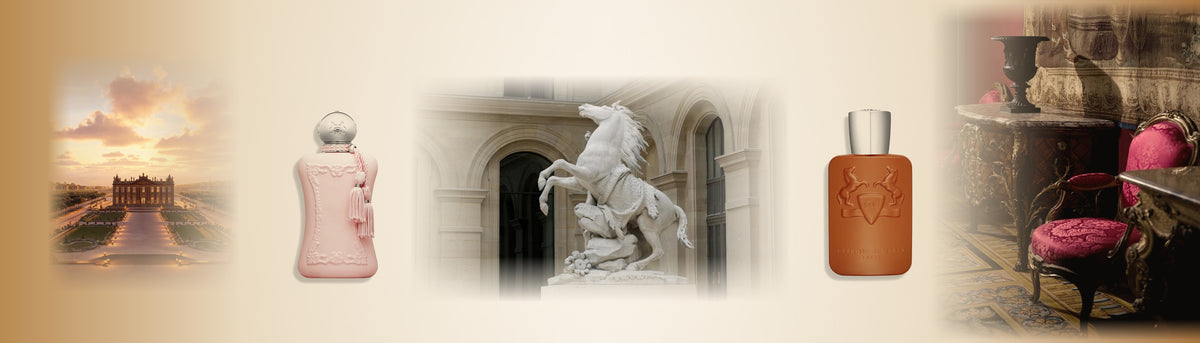
- The idea: The house tells the story of the Château de Marly, the private retreat of the French kings, and of the 18th-century passion for horses. The logo shows the famous Marly Horses.
- Typical: men's fragrances with horse names such as Godolphin or Herod, women's fragrances such as Delina and Valaya, and powerful yet very wearable compositions.
- Where to start: Althaïr for fresh vanilla, Layton for the house classic, Delina for the modern rose.
Who founded Parfums de Marly?
Julien Sprecher, a Parisian with a pronounced weakness for the 18th century. According to Parfums de Marly itself, he deliberately set out to swim against the tide: not a copy of the big fashion houses, but a perfume house with its own story, its own aesthetic and fragrances you recognise from across the room. In 2009 he released the first creations, among them Darley and Shagya, and turned a fascination with courtly life into a company.
Incidentally, the brand does not show a photo of its founder on its website, but plenty of craftsmanship instead. Sprecher prefers to stay behind his fragrances, and they speak loudly enough anyway. From the start he has worked with renowned perfumers, each bringing a very personal style:
Julien Sprecher
Founded the house in Paris in 2009 and still sets its creative direction. He also founded the parent company, which includes Initio Parfums Privés.
Hamid Merati-Kashani
According to Fragrantica the nose behind Layton (2016), one of the best-selling niche fragrances for men of all, and behind Pegasus.
Quentin Bisch
According to Fragrantica he created Delina (2017) and Delina Exclusif and later Valaya, the house's most successful women's fragrances.

What was the Château de Marly?
Imagine Versailles, just without the endless protocol. That was Marly. Louis XIV had the château built between 1679 and 1684 by his court architect Jules Hardouin-Mansart, a few kilometres west of Versailles. Here the king invited only selected guests, and here people celebrated, wore masks and laughed. An invitation to Marly was a sign of the highest favour.


The twist: the château no longer exists. It fell into decay after the Revolution and was demolished in 1806. Today only the foundations of the royal pavilion in the park of Marly-le-Roi remain. Parfums de Marly therefore had the vanished château digitally reconstructed together with historians, as a 3D tour on its own website. A perfume house named after a place none of its customers could ever enter: that takes some nerve.
To supply the fountains of Marly and Versailles, a gigantic pumping station was built on the Seine, the Machine de Marly. It pumped water from the river up the hillside so that the royal fountains could play.
Why does the Parfums de Marly logo show two horses?
Because the most famous residents of Marly were made of marble. In 1743 Louis XV chose the designs of the sculptor Guillaume Coustou for two rearing horses held by their tamers. In 1745 the Carrara marble sculptures were installed in the park of Marly. In 1794 they moved to the Place de la Concorde in Paris, at the start of the Champs-Élysées. Since 1984 the originals have stood safely in the Louvre, in the Cour Marly; what you see on the Concorde today are copies.

These are exactly the horses in the Parfums de Marly logo, together with the year 1743. You see the emblem on every bottle, and the brand story revolves around the 18th-century passion for horses: Louis XV loved horse racing, and his court was known as the “perfumed court”. How much of this is history and how much a beautiful legend is something historians enjoy debating. For your nose it makes no difference.
Why are the men's fragrances named after racehorses?
This is where it gets exciting for horse lovers. Every English Thoroughbred today, every racehorse from Ascot to Kentucky, traces back to three foundation stallions: the Byerley Turk, the Darley Arabian and the Godolphin Arabian. All three lend their names to Parfums de Marly fragrances: Darley (2009), Godolphin (2010) and Byerley (2014). Herod (2012) is named after a famous 18th-century stallion who carried on the Byerley Turk's bloodline.
The Arabian Breed collection from 2013 goes one step further. Habdan, Hamdani, Kuhuyan and Oajan are names of classic strains of the Arabian horse. So if you wear Oajan, a warm honey-amber scent, you are more or less wearing a pedigree. Other names such as Layton, Carlisle or Percival sound more like English country gentry than the racecourse; no historical horse is documented behind them.


Does Parfums de Marly make women's fragrances too?
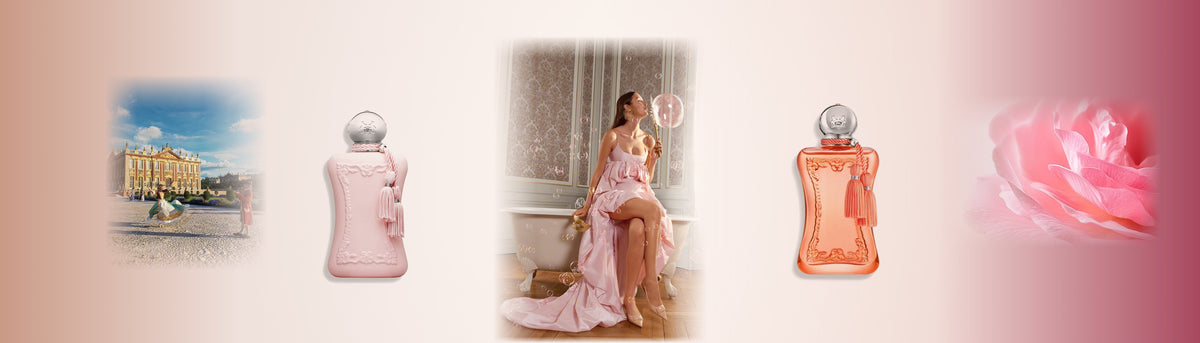
Yes, and they made the house truly famous. Parfums de Marly deliberately divides its fragrances into women's and men's lines. In 2017 Delina was launched, a juicy rose with lychee and rhubarb in a pink bottle with a tassel, and it became one of the best-known rose fragrances of our time. Delina Exclusif and Delina la Rosée followed, and in 2023 Valaya, a clean white-musk scent with orange blossom. In 2026 Athénaïs joined the family, named after Madame de Montespan, the famous favourite of Louis XIV.
Which of these florals suits you, we compare in detail in The best floral fragrances by Parfums de Marly. And if you want to know why Valaya and Athénaïs glow like that: the secret is orange blossom, more in our glossary entry Neroli or orange blossom?.


What does Parfums de Marly smell like? The house signature
Parfums de Marly makes fragrances that get noticed. Typical are a bright, often fruity opening, a clear heart and a warm, creamy base of vanilla, woods or musk. The house is not afraid of sweetness and projection, yet stays elegant. Among its raw materials Parfums de Marly names Damascena rose, natural oud and Bourbon vanilla. According to the brand, a single litre of rose essence requires around 4,000 kilograms of rose petals.
At the same time the house likes to work with modern fragrance building blocks. Valaya, for instance, contains Akigalawood, a peppery-woody material derived from patchouli, which we explain in our ingredient glossary entry on Akigalawood. There are also different concentrations: alongside the Eaux de Parfum, the Extraits Carios, Eragon and Valero have been available since 2025. What the terms mean is explained in Eau de Toilette, Eau de Parfum or Extrait?.

How big is Parfums de Marly today?
Bigger than you would expect of a niche brand. In 2023 the investment firm Advent International acquired a majority stake in Parfums de Marly and its sister brand Initio; Julien Sprecher kept a stake and creative responsibility. In 2022 revenue was 262 million euros according to FashionNetwork. For the financial year to March 2026 the trade press reported around 780 million US dollars in retail sales, up 42 percent.
The house has its own boutiques in Paris on Rue Saint-Honoré, in New York on Madison Avenue, in Beverly Hills and in London, among others. The bottles are made in France, half from recycled glass according to the brand, and the alcohol comes from French sugar beet.
Curiosities about Parfums de Marly
Something to share at your next dinner
- Named after a phantom
The Château de Marly was demolished in 1806. So the perfume house bears the name of a palace that has not stood for more than 200 years.
- The horses are copies
Anyone looking up at the Marly Horses on the Place de la Concorde sees replicas. Guillaume Coustou's originals have been in the Louvre since 1984.
- Three stallions, all racehorses
Darley, Godolphin and Byerley are the three foundation stallions of the English Thoroughbred. Every racehorse today descends from them, and each one has its own fragrance at Parfums de Marly.
- Patron of the Louvre
Since 2024 Parfums de Marly has supported the Louvre, funding the restoration of the rooms with furniture by the cabinetmaker Charles Cressent in the Department of Decorative Arts.
- A royal mistress as a fragrance
Athénaïs is named after Madame de Montespan, who called herself Athénaïs and for years was the most influential woman at the court of Louis XIV.
- Beets instead of grapes
According to Parfums de Marly, the alcohol in the bottles is made from unused parts of French sugar beet. Since 2021 the house has also been planting trees with Reforest'Action.

Which Parfums de Marly fragrance suits me?
A little guide, no knowledge of pedigrees required:
- You like vanilla, but not heavy? Althaïr, our best-selling fragrance from the house. We introduce the new, more intense version in Althaïr Exclusif.
- You want the classic? Layton, fresh, spicy and with a warm vanilla base, a perennial favourite since 2016.
- Rose, but modern? Delina. Whether the Exclusif version suits you better, we explain in Delina or Delina Exclusif?.
- Clean like fresh laundry? Valaya, or the creamier Valaya Exclusif, compared in Valaya or Valaya Exclusif?.
- Warm, honey-sweet and noble? Oajan from the Arabian Breed.
- Founded: 2009 in Paris by Julien Sprecher.
- Logo: the Marly Horses by Guillaume Coustou, with the year 1743.
- Château de Marly: built 1679 to 1684 for Louis XIV, demolished in 1806.
- Horse names: Darley, Godolphin and Byerley after the three foundation stallions of the Thoroughbred.
- Ownership: majority-owned by Advent International since 2023, Sprecher keeps a stake.
Frequently asked questions about Parfums de Marly
Where is Parfums de Marly from?
Parfums de Marly is a French perfume house from Paris. It was founded in 2009 by Julien Sprecher.
What does the name Parfums de Marly mean?
The name refers to the Château de Marly, the private retreat of the French kings near Versailles. The château was demolished in 1806.
Why does Parfums de Marly have horses in its logo?
The logo shows the Marly Horses, sculptures by Guillaume Coustou chosen by Louis XV in 1743. The originals stand in the Louvre today.
What is the best-known Parfums de Marly fragrance?
Among the best known are Layton, Delina, Althaïr and Valaya. At 4D OUTFITTERS, Althaïr is the house's best-selling fragrance.
Are Parfums de Marly fragrances unisex?
The house divides its fragrances into women's and men's lines. Many customers wear them regardless, Althaïr or Valaya for example.
Can I try Parfums de Marly fragrances before buying?
Yes. With every fragrance order at 4D OUTFITTERS you receive a sample of the scent you ordered, and via the order note you can choose up to four additional free samples. Or test the fragrances in our boutique in Bregenz.
Smell first, then fall in love
Racehorse or rose: Parfums de Marly fragrances only reveal their character on your skin. That is why we include a sample of the ordered scent with every fragrance order, and via the order note in the cart you can request up to four additional free samples, for example Althaïr, Layton and Delina for a little ride through the house. Shipping is free from € 200.
Or visit us in our boutique in Bregenz and explore the entire Parfums de Marly collection with your nose. If you want to dive deeper into vanilla, you will find more ideas in Gourmand perfume: 7 scents good enough to eat.
Your 4D OUTFITTERS team, Bregenz
Sources: Parfums de Marly – Vision · Parfums de Marly – Château · Parfums de Marly – Savoir-faire · Parfums de Marly – Louvre · Parfums de Marly – Héritage · Wikipedia: Parfums de Marly · Wikipedia: Château de Marly · Wikipedia: Marly Horses · Wikipedia: Thoroughbred · Fragrantica · Premium Beauty News · Premium Beauty News 2026 · FashionNetwork




Leave a comment
This site is protected by hCaptcha and the hCaptcha Privacy Policy and Terms of Service apply.