
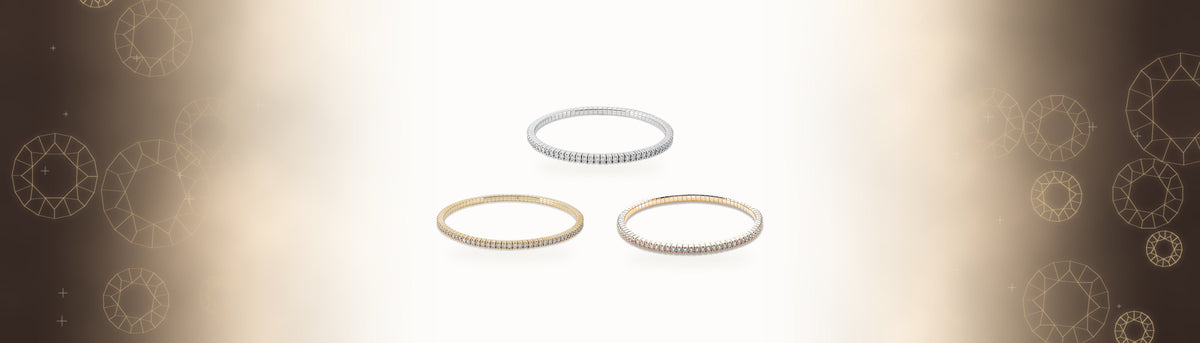
Tennis Bracelet: What Really Matters When Buying One
A match point, a broken clasp and a world-class player searching the court for her diamonds: that is how the tennis bracelet got its name. Today the slim line of equally sized stones is one of the great classics of fine jewellery. We explain how to recognise a good tennis bracelet, what setting, carat and certificate mean, how it should fit and how to care for it – with examples from our boutique in Bregenz.
- Tennis bracelet is the name for a continuous line of equally sized stones, usually brilliant-cut diamonds, in a flexible setting.
- The name goes back to Chris Evert, who lost her diamond bracelet at the US Open. Whether in 1978 or 1987, the sources differ.
- The prong setting is the most popular choice according to GIA, because a lot of light reaches the stones.
- The carat figure states the total weight of all stones. Divide it by the number of stones and you know the size of each stone.
- The right length: wrist circumference plus about 1.3 to 2.5 centimetres; one finger should fit underneath.
Why is it actually called a tennis bracelet?
Because a bracelet fell to the ground in the middle of a tennis match. The American Chris Evert wore a slim bracelet of diamonds and gold at the US Open. The clasp gave way, play was interrupted, and Evert searched the court for her stones. When she was later asked about the piece, she called it her "tennis bracelet".
The year is where it gets exciting. GIA, the Gemological Institute of America, says 1987. Evert's own camp speaks of 1978, the first year of the US Open at Flushing Meadows. And research by the magazine Mental Floss found the term "tennis bracelet" in a newspaper as early as December 1986. What is certain: the name emerged in the late 1970s or the 1980s, and Chris Evert made it famous.
How do you recognise a good tennis bracelet?
By three things: even stones, a solid setting and a secure clasp. GIA points out that small diamonds in a piece of jewellery must match in colour and brightness. If one stone is darker or lighter than its neighbours, it stands out immediately in the long line.
As for the metal, 18 karat gold is the classic. That means 750 parts gold per 1,000; the rest are alloy metals for colour and hardness. White gold is usually also rhodium-plated so that it shines brightly. According to GIA, this layer may need refreshing every few years on tennis bracelets. Which gold colour suits you is explained in our article Yellow gold, white gold or rose gold.
Prong, bezel or channel: which setting is best?
For maximum sparkle the prong, for maximum protection the bezel. GIA calls the prong setting the most popular choice for tennis bracelets, because light also enters the stones from the side. All tennis bracelets with brilliant-cut diamonds shown in this article are set with four prongs.
Small metal claws hold the stone. Lots of light, lots of brilliance. The prongs should be checked regularly, because they can catch on jumpers.
In a bezel a metal rim surrounds the stone; in a channel the stones sit between two walls. A little less light, but smooth edges and good protection.
What do carat, TW and si mean on a tennis bracelet?
On a tennis bracelet the carat figure is almost always the total weight of all stones. One carat is 0.2 grams or 100 points. It gets exciting when you divide the weight by the number of stones. Then you see how large each diamond is, and that completely changes the character of the bracelet. The abbreviations TW, si and vsi describe colour and clarity; they are explained in detail in our article TW-si, vsi, brilliant: what the diamond abbreviations mean.
| Bracelet | Stones | Total | Per stone (avg.) | Quality | Length |
|---|---|---|---|---|---|
| Premium DD5G69037W | 100 brilliants | 0.93 ct | approx. 0.9 points | TW/si | 17.5 cm |
| Premium DD5G69569W | 95 brilliants | 1.34 ct | approx. 1.4 points | TW/si | 17.7 cm |
| Flex 5E441W | 79 brilliants | 2.64 ct | approx. 3.3 points | TW-si | approx. 17 cm |
| GIA Premium DD5G69574W | 35 brilliants | 17.65 ct | approx. 50 points | TW/vsi | 18.0 cm |
All four in 18 kt white gold with four-prong settings. Details according to the product descriptions, as of 22 Oct 2026.
The maths is fun: a single stone of the GIA Premium bracelet weighs, on average, as much as around 54 stones of the delicate Premium model. In return, the delicate model has more facets. A brilliant has 57 or 58 facets, so 100 brilliants bring at least 5,700 tiny mirrors to the wrist, the 35 large stones around 2,000. Two completely different ways of sparkling: one like fine stardust, the other like a chain of points of light.
 GIA Premium DD5G69574W35 brilliants, 17.65 ct€ 43,790
 Premium DD5G69569W95 brilliants, 1.34 ct€ 5,980
 Flex 5E441W white gold79 brilliants, 2.64 ct€ 11,690
 Flex 5D953R rose gold82 brilliants, 2.53 ct€ 13,890
Live prices from our shop, as of 22 Oct 2026. You can see all pieces in the 4D Outfitters Fine Jewellery collection.
What is in a GIA certificate – and when is it worth it?
A GIA report is an independent assessment of a diamond according to the 4Cs: carat, colour, clarity and cut. GIA was founded in 1931; its founder Robert M. Shipley developed the 4Cs as a memory aid. In 1953 the colour scale from D to Z was introduced, which is the worldwide standard today.
Important for tennis bracelets: GIA issues the classic Diamond Grading Report for loose natural diamonds of 0.15 carat and above. For very small stones this is unusual. For a finished, set piece of jewellery there is the Jewelry Report, which gives weight, colour and clarity only as ranges, as far as the setting allows a view. That is why a bracelet like our GIA Premium DD5G69574W is something special: 35 stones of around half a carat each, and a separate GIA certificate for every stone. How carat weight shapes the value of a diamond is explained in Carat: the first C of the 4Cs.
Classic bracelet chain or flex bracelet: which suits you?
The classic tennis bracelet chain lies around the wrist as softly as a ribbon and is usually closed with a box clasp. Good models also have a safety catch, such as a side figure-eight that hooks over the clasp. GIA recommends exactly such a second safety and regular checks by a jeweller.
Our flex bracelets, by contrast, are flexibly set bangles with a titanium spring. They sit round, follow the movement of the wrist and combine beautifully with a watch or other bracelets. We have them in white, rose and yellow gold, and not only with diamonds. Coloured stones such as ruby, emerald or sapphire bring colour into play. Good to know: coloured gemstones are frequently treated in the trade, for example heated. Feel free to ask us about the details of each piece.
 Flex 5D151R rubies81 rubies, 2.69 ct€ 8,490
 Flex 5D325G emeralds59 emeralds, 5.39 ct€ 12,980
 Bracelet chain sapphires62 sapphires, approx. 2.10 ct€ 7,390
Live prices from our shop, as of 22 Oct 2026.
How long should a tennis bracelet be?
Measure your wrist just above the wrist bone and add about 1.3 to 2.5 centimetres: less for a snug fit, more for a looser one. GIA recommends a comfortable but snug fit in which just one finger fits between wrist and bracelet. If it sits too loosely, the bracelet turns, the stones face downwards and the clasp is put under more strain. Depending on the version, our models range from about 16.5 to 19 centimetres. With the classic tennis bracelet chain in white gold with diamonds you can even choose between 17, 17.8 and 19 centimetres.
How do you care for a tennis bracelet properly?
Gently and regularly. GIA recommends warm water with a few drops of mild washing-up liquid and a soft toothbrush. Chlorine bleach, abrasive cleaners and toothpaste are off-limits. Ultrasonic and steam cleaners can loosen stones in their settings; with a bracelet of almost a hundred stones, that is not an experiment for home.
With a hardness of 10 on the Mohs scale, diamond is the hardest mineral, but not indestructible: a hard blow can cleave a diamond. And diamonds scratch other jewellery. So store the bracelet on its own in a padded case. A quick check of prongs and clasp by a jeweller, about every six months according to GIA, is the best insurance. Feel free to ask us about it in Bregenz.
Curiosities about the tennis bracelet
From centre court to your wrist
- "I just dropped it"
In a 2018 interview, Chris Evert said, in essence, that she lost the bracelet on court at the US Open and that from then on it was called the tennis bracelet.
- The name was faster than the legend
According to Mental Floss, the term appeared as early as December 1986 in a gift guide of the Fort Worth Star-Telegram, in other words before the 1987 US Open.
- Almost 6,000 mirrors
100 brilliants with 57 facets each add up to 5,700 facets. The most delicate bracelet in our table therefore has more facets than the largest.
- Half a carat per stone
35 stones totalling 17.65 carats give an average of just over 0.5 carat per stone, as much as in many an engagement ring.
- Weight in points
A carat has 100 points. The stones of our most delicate bracelet weigh less than one point on average, that is less than two thousandths of a gram.
- A memory aid with a global career
The 4Cs were originally a mnemonic of GIA founder Robert M. Shipley. Today the whole industry uses them.
- Fineness: 18 karat equals 750 parts per thousand of gold.
- Weight: 1 carat = 0.2 grams = 100 points; the figure on bracelets is usually the total weight.
- Brilliant: 57 facets, 58 with a culet (33 on the crown, 24 or 25 on the pavilion).
- GIA reports: Diamond Grading Report for loose natural diamonds from 0.15 ct; for set pieces the Jewelry Report with ranges.
- White gold: usually rhodium-plated; on tennis bracelets, according to GIA, to be re-plated every few years.
Frequently asked questions about the tennis bracelet
What is a tennis bracelet?
A tennis bracelet is a slim bracelet made of a continuous line of equally sized stones, usually brilliant-cut diamonds, each set individually and flexibly.
Why is it called a tennis bracelet?
The tennis player Chris Evert lost her diamond bracelet on court at the US Open, and play was interrupted. Afterwards she called it her tennis bracelet. The years given are 1978 and 1987.
Which setting is best for a tennis bracelet?
The prong setting brings the most light into the stones and is the most popular choice according to GIA. Bezel and channel protect the edges of the stones better but look a little calmer.
How long should a tennis bracelet be?
Wrist circumference plus about 1.3 to 2.5 centimetres. One finger should fit comfortably between wrist and bracelet.
What does the carat figure on a tennis bracelet mean?
It usually states the total weight of all stones. Divide it by the number of stones and you get the average weight of a single stone.
How do I clean a tennis bracelet?
With warm water, a little mild washing-up liquid and a soft toothbrush. Avoid ultrasonic and steam cleaners, bleach and abrasive cleaners.
Most beautiful on your own wrist
A tennis bracelet has to be worn to be understood: how it moves, how it works with your watch, whether you prefer stardust or large points of light. Visit us in our boutique in Bregenz: we will gladly lay several models side by side, measure your wrist and explain certificates and stone quality. We are happy to arrange a quiet appointment for this; just send us a message.
Your 4D Outfitters team, Bregenz
Sources: GIA: Tennis Bracelet Buying Guide · GIA: Tennis Bracelet · GIA: Settings · GIA: Design with Melee · GIA: About · GIA: History of the 4Cs · GIA: Carat Weight · GIA: Diamond Grading Report · GIA: Jewelry Report · GIA: Anatomy of the round brilliant · GIA: Diamond Care · GIA: Protection and care · World Gold Council: Gold Jewellery · The Adventurine: Chris Evert · Mental Floss: Tennis Bracelet Origins · Vogue Singapore · VRAI: Bracelet size



Leave a comment
This site is protected by hCaptcha and the hCaptcha Privacy Policy and Terms of Service apply.